
Cottages rarely give you the luxury of a long, uninterrupted run of wall units. Windows sit low, beams drop into the room, chimney breasts bulge out and doors open awkwardly into cupboards. Filling every gap with a tall carcass can make a small room feel like a corridor of chipboard.
Open shelving solves several of these problems at once. A single shelf of 25–30mm oak, fixed on simple brackets, needs only 200–250mm of depth, so it can sit above a window sill or run past a beam where a cabinet door could never swing open. It also lets you use the awkward spaces — beside a chimney breast, above a butler sink, along a short return wall — without blocking light.
The trade-off is honesty: everything on show needs to earn its place. If you cook hard and often, plan for a practical mix rather than a styled display. Keep the items you reach for daily on the lowest shelf, and put the good china higher, where it gathers less grease.
Stone worktops are the natural partner to open shelving in a period kitchen, because the texture softens what could otherwise look like a hard, modern run. For cottages, a honed or brushed finish almost always reads better than a high-polish gloss. Honed limestone, slate and granite all work beautifully, and dark slate in particular sits well against lime plaster and painted timber.
Practical points worth knowing before you order:
Natural stone needs sealing, usually annually, and it will patina — a ring from a hot pan, a faint mark near the kettle. In a cottage that wear looks like history rather than damage. If you want zero maintenance, a matte quartz is the compromise, though it will feel more contemporary.
Alcoves are the cottage kitchen's secret weapon. Those shallow recesses either side of a chimney breast are hopeless for standard units but ideal for a tailor-made arrangement.
A good pattern for a 600–900mm alcove is a low cupboard or open basket bay at the base, a stone or timber worktop at 900mm, then two or three shelves above, set 300–350mm apart. The base hides the ugly items — bins, cleaning products, the dog's biscuits — while the shelves carry the things you want to see. If the alcove is very shallow, forget the cupboard and run full-height shelves instead.
Where walls are wonky, which they will be, have the shelves scribed to fit rather than forced square. A carpenter can cut a template from cardboard or thin ply and transfer the curve to the shelf end. It costs a little more and looks enormously better. Allow a small expansion gap in solid timber and finish it with a bead of flexible caulk painted to match.
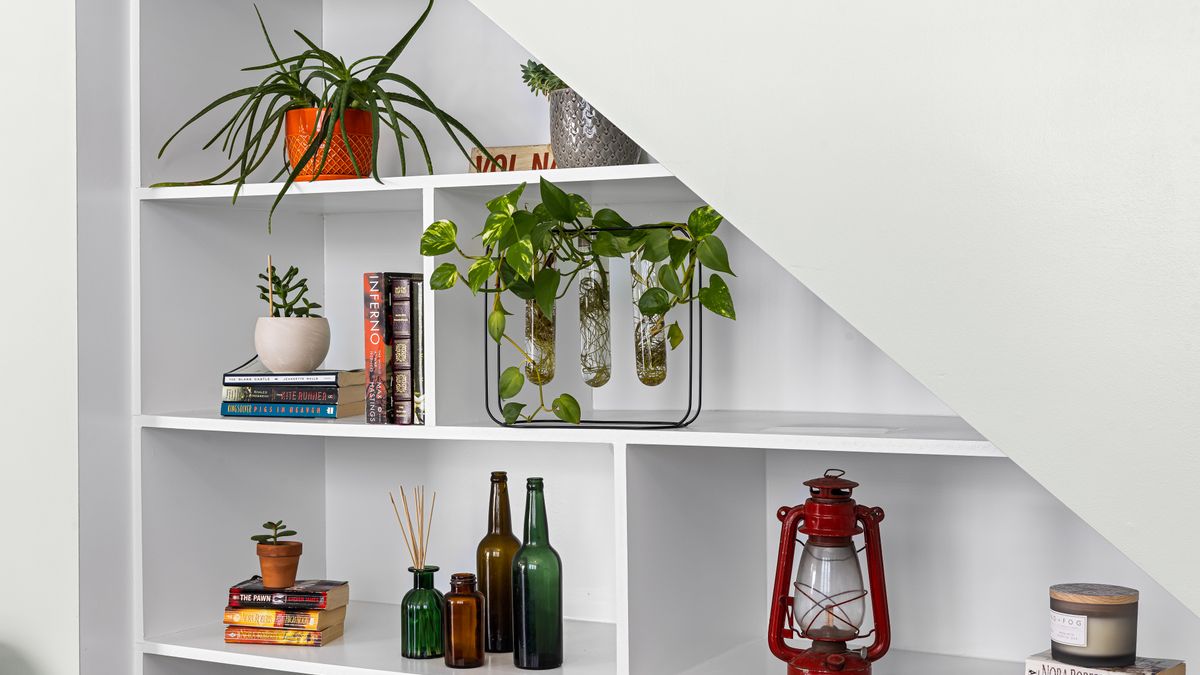
The most appealing cottage shelves are not styled for a photograph — they are arranged for use. A few rules keep them looking calm:
Add a couple of non-kitchen items: a small potted herb, a candle in a jam jar, a wooden board propped at the back. In a very small kitchen, use the top shelf for baskets holding less attractive things, and keep the lower two for display.
Open shelving only works if you can see what's on it. Under-shelf LED strip in a warm 2700K colour temperature makes crockery glow and gives useful task light over the worktop. Run it on a dimmer so the kitchen can shift from working to evening without switching on the ceiling light.
Hardware should be understated. Aged brass, black iron or simple turned timber knobs all suit a cottage; long stainless bar handles rarely do. If you are painting cabinetry, choose a chalky off-white, a soft sage or a muted grey-blue, and use a durable eggshell or a specialist kitchen finish rather than standard emulsion.
If your cottage is listed, check before fixing anything to original fabric, and remember that solid stone or brick walls need to breathe. Modern gypsum plaster and vinyl paints trap moisture; lime plaster with a breathable paint lets it out. Keep shelving off external walls where damp is a risk, or use a ventilated batten behind.
Finally, don't over-restore. A slightly uneven shelf, a stone worktop with a visible seam and a wall that isn't quite plumb are all part of the charm. Match the new work to the old, keep the practical stuff within easy reach, and the room will feel both hardworking and genuinely warm.

Hi, my name is Anthony kuber. I am artist and fashion designer.
I love to travel and writing blogging.
Your email address will not be published. Required fields are marked *
Software Developer & Writer
Hey, I'm Diva, a developer and writer blending code and creativity. I'm driven by a deep curiosity and a relentless pursuit of excellence. Join me as I craft digital solutions and captivating stories.


